
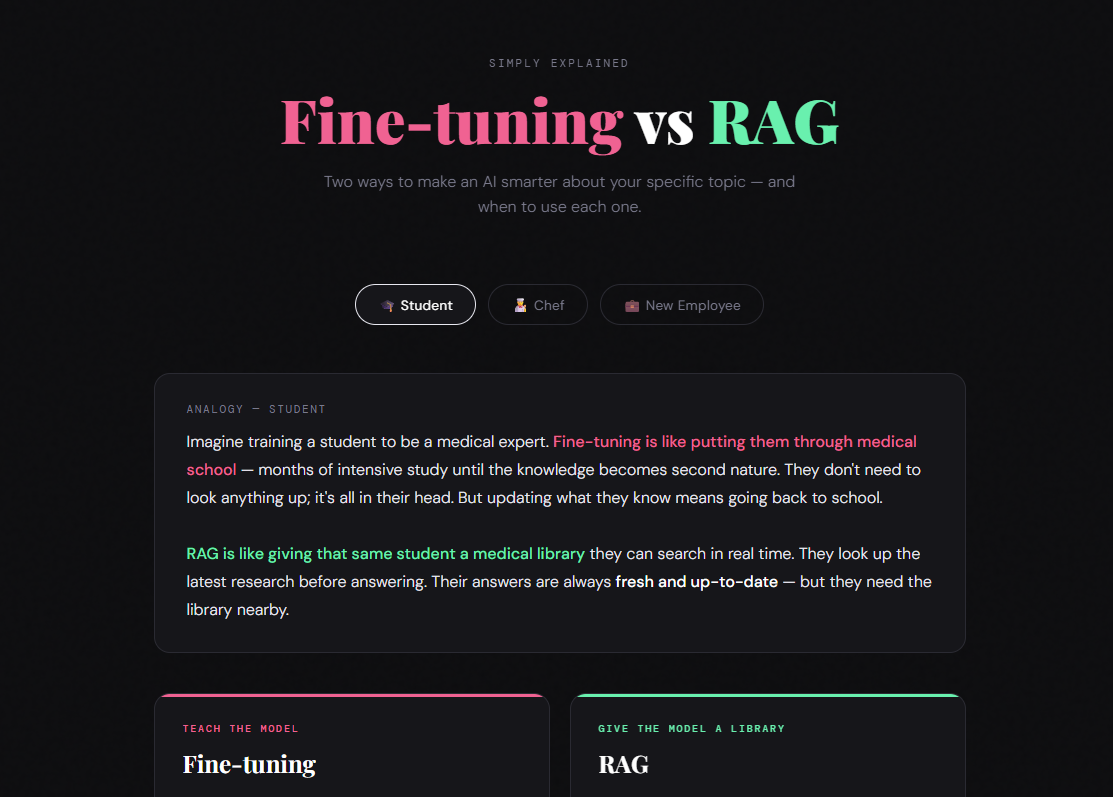

Simply Explained
Fine-tuning vs RAG
Two ways to make an AI smarter about your specific topic — and when to use each one.
Analogy — Student
Imagine training a student to be a medical expert. Fine-tuning is like putting them through medical school — months of intensive study until the knowledge becomes second nature. They don’t need to look anything up; it’s all in their head. But updating what they know means going back to school.
RAG is like giving that same student a medical library they can search in real time. They look up the latest research before answering. Their answers are always fresh and up-to-date — but they need the library nearby.
RAG is like giving that same student a medical library they can search in real time. They look up the latest research before answering. Their answers are always fresh and up-to-date — but they need the library nearby.
Analogy — Chef
Fine-tuning is like training a chef to memorize your restaurant’s entire menu — every recipe, every technique, baked into muscle memory. Fast, fluent, no hesitation. But if the menu changes, they need retraining.
RAG is like giving a chef a constantly updated recipe book they can flip through before cooking. The menu can change every day and they’ll always make the right dish — as long as the book is accurate and at hand.
RAG is like giving a chef a constantly updated recipe book they can flip through before cooking. The menu can change every day and they’ll always make the right dish — as long as the book is accurate and at hand.
Analogy — New Employee
Fine-tuning is like an intensive onboarding program — weeks of training until the employee deeply understands your company’s culture, tone, and processes. They just know how things work here.
RAG is like giving a smart new hire access to the company wiki and Notion docs. They look things up as needed. Add a new policy today and they’ll know it tomorrow — no retraining required.
RAG is like giving a smart new hire access to the company wiki and Notion docs. They look things up as needed. Add a new policy today and they’ll know it tomorrow — no retraining required.
Teach the model
Fine-tuning
You retrain an existing AI model on your own data, so the new knowledge becomes baked directly into its weights — part of who it is.
- Knowledge is internalized, not looked up
- Faster responses — no retrieval step needed
- Great for style, tone, and format changes
- Expensive and slow to update
- Can “forget” or hallucinate outdated info
Give the model a library
RAG
Retrieval-Augmented Generation. The AI searches a knowledge base at query time and uses what it finds to answer — like open-book vs closed-book.
- Knowledge stays fresh — update docs, not the model
- Answers are grounded in real, citable sources
- Great for large, changing knowledge bases
- Slightly slower due to retrieval step
- Only as good as the documents it can find
How each approach works
Fine-
tuning
tuning
Base Model
+ your data ──▶
Trained Model
──▶
Answer
Your data is baked in permanently. Fast at inference, but costly to update.
RAG
Base Model
◀── fetches ──
Your Docs
Model + context
──▶
Answer
Docs stay separate. Model retrieves relevant chunks at query time — always up to date.
How they compare
High cost
Training cost
Low cost
Slow to update
Knowledge freshness
Always fresh
Strong
Tone & style control
Weaker
Harder
Ease of setup
Easier
Can hallucinate
Factual reliability
Cites sources
◀ Fine-tuning wins here
RAG wins here ▶
💡
Most production AI systems use both together.
Fine-tune the model to speak in your brand’s voice and format.
Use RAG to give it access to your latest documents and data.
They’re complementary, not competing.
Use RAG to give it access to your latest documents and data.
They’re complementary, not competing.
When would you use each?
Use Fine-tuning when…
You need a specific tone, style, or persona
Your data is stable and doesn’t change often
You want the model to follow a strict format
Speed matters and you can’t afford retrieval latency
Teaching skills, not facts (e.g. “write like us”)
Use RAG when…
Your knowledge base changes frequently
You need answers grounded in specific documents
You want the AI to cite its sources
You have a large library of internal docs or PDFs
Building a Q&A bot over your own content

0 Comments